





Course of Applied Geometry,
Department of Pure and Applied Mathematics
Associate Professor
Akihiro Higashitani
You actively engage with researchers overseas. What kind of interactions do you have?
During my postdoctoral years at the University of Osaka and Kyoto University, I was fortunate enough to secure substantial research funding, which I used to visit various researchers abroad. I often stayed with them for several weeks to conduct joint research.
In Japan, the only people researching Ehrhart theory are Professor Hibi’s former students, including myself. However, if we look abroad, there are many researchers, primarily in Germany and the United States. I wanted to learn how they were conducting their research and absorb new ideas. Of course, I could read their papers, but to deepen my understanding and learn about the latest research beyond what’s in the papers, the best approach is to go and meet them in person. I began traveling to Germany, the United States, the United Kingdom, Canada, and other countries about three times a year, staying for two to three weeks each time to discuss with various researchers.
My approach to research remains unchanged to this day. I currently hold Grant-in-Aid for Fund for the Promotion of Joint International Research (Fostering Joint International Research) *1 through the Japan Society for the Promotion of Science (JSPS). As part of this initiative, I recently hosted an academic conference *2 at the Max Planck Institute in Leipzig, Germany, where researchers of Ehrhart theory from around the world gathered for lively discussions.
*1 代数的手法および組合せ論的手法を用いた格子凸多面体論における未解決問題への挑戦 (国際共同研究強化(B) 2021年10月 - 2026年3月)
*2 RECENT DEVELOPMENT ON LATTICE IN LEIPZIG(2026年1月20日-23日)
The problems that come to mind in a straightforward way are usually the same ones that many others have thought of, and they are either already well-researched or too difficult for anyone to solve.
I begin my research by asking myself, “What about this scenario?” and searching the literature to try various approaches. In doing so, I discover unsolved problems where I think, “This problem is difficult, but I feel I could solve it myself, and no one else has managed to do so yet.” In my research, defining the right problem is far more significant than the time spent solving it. In fact, 80% of my research involves searching for and defining problems. This 80% includes actively organizing conferences and collaborating with researchers abroad, engaging with the latest research and holding repeated discussions.
Please tell us about the characteristics and atmosphere of your lab.
My lab is engaged in global academic exchange within the niche field of Ehrhart theory.
As of January 2026, we have five master’s students and three PhD students (including one international student), but only two of them are graduates of the University of Osaka. The rest have come from universities all over Japan. While some students became interested in Ehrhart theory specifically within pure mathematics, quite a few others were drawn to my lab after developing an interest in commutative ring theory during their undergraduate studies.
I make it nearly mandatory for PhD students to spend about one month abroad for research. We utilize research grants for collaborative projects with students, sending them abroad in my place to gather the latest research information.
On the other hand, many overseas researchers also visit my lab. In the past, several people have joined my lab through JSPS Postdoctoral Fellowship for Overseas Researchers, and just this morning, I had an online meeting with a postdoc from the U.S. who was seeking similar advice.
I also aim to regularly accept international students into my PhD program; two years ago, a student from India completed their Ph.D., and last year, a student from Germany did the same. Currently, we have one Chinese student enrolled. Many of them come through referrals from my international collaborators.
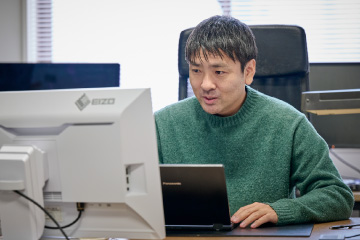
As for the atmosphere, even though we’re part of IST, our lab operates in a style where we mainly clatter away with pen and paper. During seminars, I‘ll suggest, “Let’s think about this problem for a moment,” using the blackboard in the lab, or conversely, students will propose, “This equation holds true.” Of course, we do use computers to write programs and perform calculations, but our approach is fundamentally analog. That might make us a bit of an oddity even within IST.
By the way, almost all students who earn their degrees in my lab aim to pursue careers as researchers. However, with the growing activity in AI development and other fields, I’ve noticed that the demand for professionals with degrees in mathematical sciences is increasing year by year. Also, among master’s graduates, many students go on to work in the financial sector—such as banks, life insurance, and property and casualty insurance—as well as in manufacturing, engineering, or teaching.