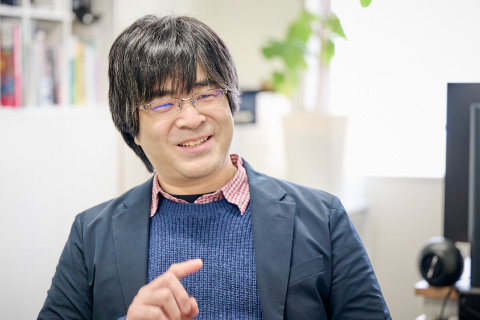






Course of Computer Vision,
Department of Multimedia Engineering
Associate Professor
Okura Fumio
Could you tell us about the research you are currently conducting with support from KAKENHI and JST FOREST?
We are conducting basic research with the ultimate goal of leading to real-world applications. There is already a great deal of research focused on applying existing technologies, which I also support. For this reason, in my research grants and JST FOREST projects, I am more interested in creating the underlying foundational technologies.
Currently, I am focusing on developing foundational technologies to reconstruct plant structures. The ultimate goal is to create a complete virtual plant model using plant data acquired from cameras and other sources. In other words, this involves generating a digital twin of the plant. We aim to reproduce not only the plant’s shape but also its branch and leaf structure, as well as temporal changes—including occluded areas—from a set of images of the plant.
If this technology is realized, it will enable cultivation simulations and genetic mapping using digital twins. This will provide a powerful tool for automating cultivation and accelerating breeding (variety improvement), which should have a significant impact on the fields of plant science and agriculture.
Furthermore, in the field of breeding, research by myself and many others has accumulated insights allowing us to judge the quality of genes based on a plant’s phenotype—for example, determining that “the genotype of a germinated plant exhibiting this appearance or trait is superior.” We hope to eventually compile this into a database to support the rapid variety improvement required in today’s era of severe climate change.
Additionally, while plants have complex forms, we are discovering that there are rules (constraints) governing their structure and growth. We are also working to systematize technologies for generating three-dimensional reconstructions of plants and digital twins based on these rules.
Ultimately, we aim to accelerate the growth of plant digital twins in a virtual space to improve the predictability and efficiency of cultivation and breeding. Our goal is to reach this field, often referred to as “plant design,” and, if possible, we hope to develop technology capable of designing plants and predicting their growth by around 2030.

What do you think makes the Institute of Science and Technology (IST) at the University of Osaka so appealing?
Osaka University has a cutting-edge mindset. I can confidently say that, not just within the Graduate School of Information Science and Technology (IST), but across the university, there are many people who are driven to conduct research that ranks among the best in the world.
Even just looking at the faculty in the Department of Multimedia Engineering, where I belong, every single one of them has made a name for themselves by publishing papers in world-renowned academic journals. There is a mindset at the University of Osaka that says, “If you’ve made a discovery through your research, you should present it at a venue that is properly recognized globally,” and being able to grow in such an environment is truly meaningful.
In recent years, I myself presented the results of the JST FOREST project I mentioned earlier at ICCV 2025, a top international conference on computer vision, and have submitted an expanded version to an international journal.
To begin with, researchers at the world’s top universities and international companies like Google only have top-tier academic conferences in their sights. Of course, the path to having one’s research and presence recognized there is fraught with challenges. However, unless you keep submitting your work, the path will not open up. In the sense that it fosters a mindset of continuous challenge, I believe this university is a truly exceptional place.